 Environmental issues have long been a strategic priority for countries worldwide, and the efficient utilization of clean energy sources—such as hydropower, wind, geothermal, and solar energy—has become a key component in addressing environmental challenges and achieving sustainable development. However, the application of clean energy is constrained by geographical location and seasonality, among other factors. To improve utilization efficiency, it is essential to develop advanced secondary battery energy storage systems. Among these, lithium-ion batteries, due to their superior performance, have already achieved large-scale commercialization.
In recent years, secondary battery energy storage systems have attracted extensive research attention. Nevertheless, the electrolyte—the "lifeblood" of a battery—ultimately determines its performance metrics. Computational electrochemistry for electrolyte material design has thus become a research hotspot. However, traditional frontier molecular orbital theory fails to accurately describe the complex chemical environments within electrolytes, making it ineffective for designing practical electrolyte formulations.
Classical molecular dynamics (MD) simulations, when combined, often suffer from low accuracy in force fields, resulting in unreliable and inconsistent solvation structures and computed properties. In contrast, first-principles molecular dynamics (FPMD) simulations have gained widespread attention in recent years due to their ability to accurately describe complex chemical environments at the quantum mechanical level. By precisely calculating electronic structures and sampling via molecular dynamics, FPMD enables accurate prediction of electrochemical properties of electrolyte materials and reliable evaluation of electrolyte performance. However, the high computational cost of first-principles calculations limits their direct application in electrolyte material design.
Machine learning molecular dynamics (MLMD) overcomes this limitation by using machine learning models to fit high-accuracy first-principles data, enabling precise prediction of energy and atomic forces at a fraction of the computational cost. This allows for long-timescale MD simulations with first-principles accuracy. However, the training of machine learning potential models is heavily dependent on the quality and coverage of first-principles datasets. For general-purpose electrolyte potential models, the difficulty in constructing representative and comprehensive datasets severely limits the generalization capability of machine learning potentials.
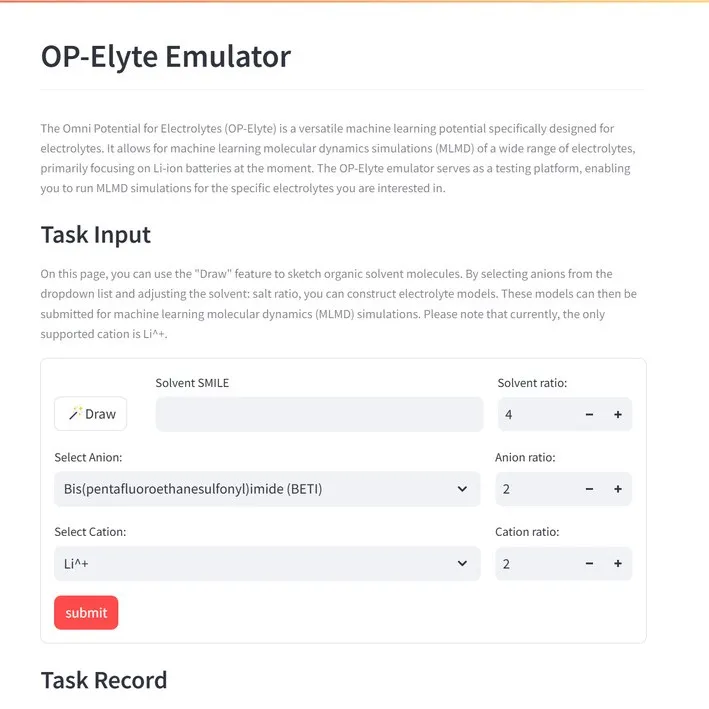
To address these challenges, AI4EC Lab has developed omni potential for electrolytes (op-elyte), a broadly applicable and relatively comprehensive general-purpose potential model for lithium-ion battery electrolyte design. Built upon the lab’s self-developed intelligent computational workflow software package ai²-kit, op-elyte enables users to design solvent molecular structures, select lithium salts, and set solvent-to-solute ratios via an intuitive interface on the AI4EC Lab website (op-elyte emulator) to automatically generate electrolyte models and perform machine learning molecular dynamics simulations. Users can simulate most conventional lithium-ion battery electrolytes, and through long-timescale statistical sampling, obtain accurate physicochemical properties such as density, viscosity, conductivity, and operational temperature range. This lays the foundation for high-throughput exploration of electrolyte chemical space and intelligent electrolyte design.
AI4EC Lab Solution
AI4EC Lab comprehensively considers the complexity of real-world lithium-ion battery electrolyte environments. By constructing molecular databases of solvents and lithium salts and leveraging the automated workflow ai²-kit, the lab has randomly generated over one million diverse electrolyte formulations. Classical molecular dynamics simulations are then performed to obtain relatively stable initial structures.
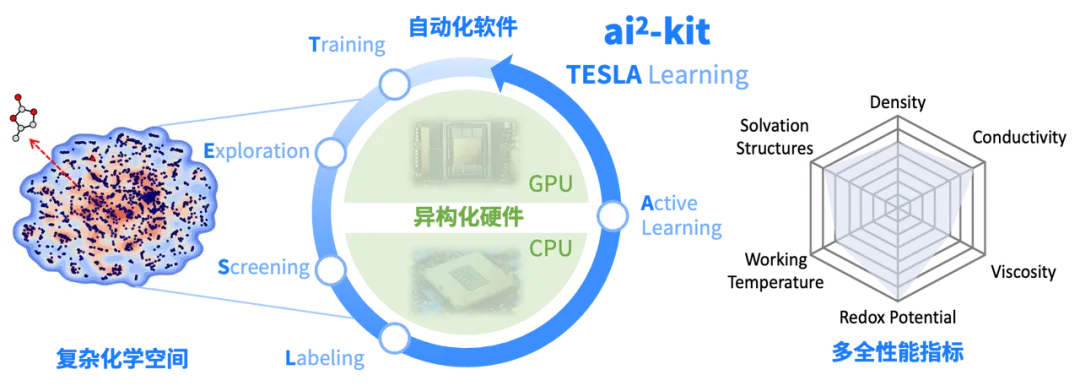
Using the self-developed ai²-kit workflow, the dataset is iteratively updated in an automated fashion to train the general-purpose potential model. Based on this model, accurate predictions of solvation structures, density, viscosity, conductivity, and operational temperature ranges can be obtained. This enables high-throughput machine learning molecular dynamics simulations to build a comprehensive electrochemical property database, accelerating the efficient and intelligent design of lithium-ion battery electrolytes.
omni potential for electrolytes (op-elyte)Dataset
Through automated training with ai²-kit, a dataset containing 240,000 density functional theory (DFT) calculation data points has been constructed. This dataset supports accurate simulations of over one million electrolyte formulations, including up to 3,000 types of solvents, 17 lithium salt anions, mixtures ranging from binary to nonary components, multiple concentration gradients, and demonstrates excellent transferability across solvent types. The general-purpose potential model can support molecular dynamics simulations for most complex lithium-ion battery electrolyte systems, delivering accurate physicochemical predictions.
Case and Access
Selected electrolyte test data are accessible via ai2-db BatElyte:
https://ai2db.ai4ec.ac.cn/batelyte
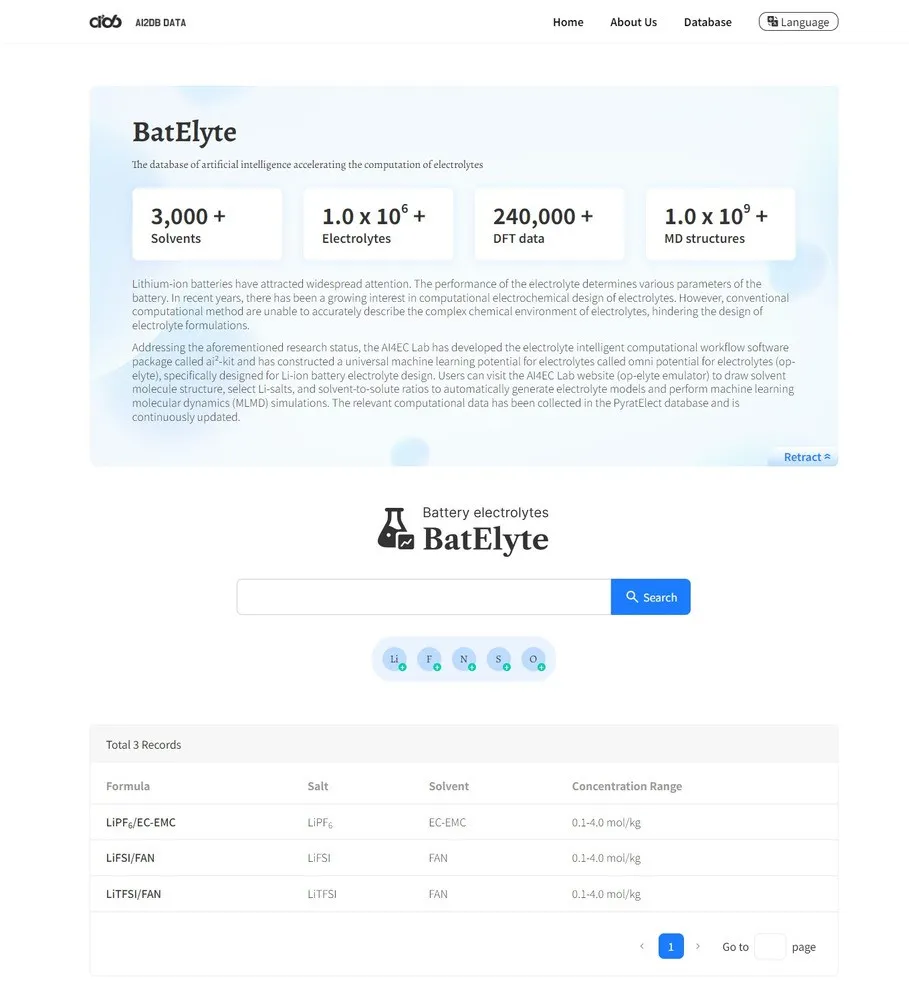
Users can test their electrolyte systems of interest using the op-elyte emulator:
https://ai4ec.ac.cn/apps/op-elyte-emulator
Outlook for omni potential for electrolytes(op-elyte)
The successful development of op-elyte provides a novel and efficient computational pathway for lithium-ion battery electrolyte research. AI4EC Lab will continue to refine the technology and expand its applications, accelerating progress in the field of secondary battery energy storage. Future work will focus on enhancing interactions with complex electrolyte systems, iterative updates of the general-purpose potential model, and improving computational accuracy.
We welcome you to join the AI4EC Lab user community to learn more and engage with developers. Please scan the QR code below to join our WeChat group.