Defect-Induced Dynamic Reconstruction Boosts Oxygen Evolution Activity of Perovskite Oxides
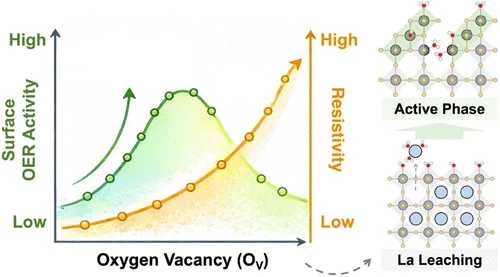
The intermittent nature of renewable energy calls for efficient storage, and electrochemical water splitting provides a route to convert electricity into green hydrogen. The oxygen evolution reaction (OER) is the kinetic bottleneck, and perovskite oxides such as lanthanum nickelate (LaNiO3, LNO) are promising catalysts. Oxygen vacancies have been proposed to enhance activity, yet their specific role remains unclear due to the dynamic interfacial structure during OER. Here, we employ epitaxial LNO thin films with controlled oxygen-vacancy concentrations, combining electrochemical atomic force microscopy (EC-AFM), Raman spectroscopy, and angle-resolved X-ray photoelectron spectroscopy (ARXPS) to track vacancy-induced structural and chemical evolution. Furthermore, based on the structural information from characterization, machine learning molecular dynamics (MLMD) is applied to elucidate the formation mechanism of the active phase. We reveal that oxygen vacancies trigger La leaching, inducing structural distortion and reconfiguration into a highly active phase identified as γ-NiOOH. These findings establish atomic-level structure–activity relationships and provide a rational strategy for designing next-generation OER catalysts.