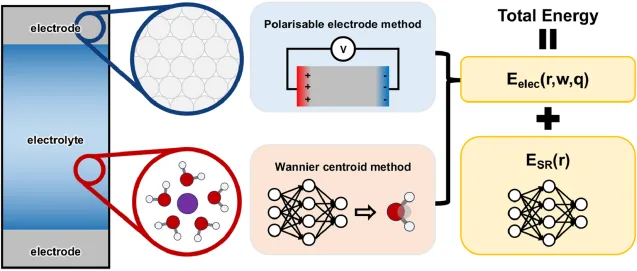
How can machine learning facilitate computational electrochemistry
Electrochemistry plays a central role in modern sustainable energy technologies, yet its computational modeling has long been constrained by the trade-off between the efficiency of classical force fields and the accuracy of ab initio methods. This limitation is particularly critical given the scarcity of experimental “ground truth” data for buried interfaces. This Perspective charts the transformative impact of machine learning on overcoming these long-standing spatiotemporal barriers. We begin with an overview of foundational methodologies, ranging from continuum models to ab initio molecular dynamics, to contextualize the unique physical requirements of the charged electrode–electrolyte interface. The discussion then focuses on the evolution of machine learning potentials, tracing their development from short-range local descriptors to advanced architectures capable of capturing long-range electrostatic interactions. A critical analysis is provided on the central challenge: accurately modeling the distinct dielectric responses of metallic conductors vs ionic insulators and the emergence of hybrid frameworks as a promising solution. Finally, we offer an outlook on the future of computational electrochemistry, arguing that the next frontier involves the synergistic integration of machine learning with multiscale modeling to bridge the gap between microscopic mechanisms and macroscopic device performance.